
Augusta Public Records Coverage
Open access depends on the record, its keeper, and any exemption. Augusta-Richmond County is consolidated, yet the records functions remain divided. The Clerk of Superior, State and Juvenile Court keeps recorded land instruments and many case files. Probate Court handles estates, marriage licenses, and local vital-record service. Assessor and GIS staff publish current property evidence. The sheriff maintains booking and law-enforcement material outside the city request portal.
| Record set | Custodian | Online route | Access |
|---|---|---|---|
| Deeds, liens and plats | Richmond court clerk | GSCCCA Real Estate Index | Index and most instruments public; older books at clerk |
| Court cases | Clerk for the named court | Local tools vary by court | Open filings, except sealed, juvenile and confidential matter |
| Property and tax roll | Tax Assessor, GIS, Tax Commissioner | Augusta Maps and tax services | Free current search; office fallback |
| Birth and death certificates | Probate/local vital office and Georgia DPH | Request service, no public name index | Eligible requester, ID and fee required |
| Marriage and divorce | Probate, Superior Court, DPH by period | Coverage varies | Open portions and copy rules depend on record |
| Bookings and offender data | Richmond sheriff, Georgia DOC and GBI | Separate official searches | Public fields, with safety and statutory limits |
A public index is not always the underlying record. An index may show names, dates, document type, and book/page, while the image or certified copy contains the full filing. Adoption material, sealed cases, juvenile files, driver data, protected addresses, and confidential identifiers do not become open merely because a broad request names them.
- Custodian
- The office that holds and answers for a specific record.
- Index
- A finding list that points to a filing; it is not always the full image.
- Certified copy
- A copy authenticated by the issuing office for uses that require official proof.
- Exemption
- A legal reason that permits or requires an agency to withhold all or part of a record.
Augusta Deed Index Access
The GSCCCA Real Estate Index is the online route for Richmond County deeds, security deeds, liens, plats, releases, and other recorded instruments. Its broad statewide coverage begins in 1990, but Richmond County's exact good-from date was not captured. Use the portal's county-specific date control before assuming a local starting year. Older books and uncertain hits go to the clerk at the counter or by phone.
| Search field | How to use it | Format or choices |
|---|---|---|
| Party Type | Choose the person's role | All Parties, Grantor, or Grantee |
| Instrument Type | Narrow deeds, liens, plats and other filings | All Instruments or a named filing type |
| County | Limit the statewide index | Select Richmond; neighboring-county option available |
| Search Name | Search an individual | Last name, first name |
| Result dates | Reduce a long name list | Optional date range |
| Book/Page | Open a known citation | County, book and page required |
Grantor means the party transferring an interest; grantee means the party receiving it. A result can lead to the recorded image, where return-to addresses, legal text, and transaction detail may go beyond the index row. Record the document number and book/page before ordering a copy.
Note: If no online deed appears, try party-role changes and name variants, then ask the clerk about pre-online books and local coverage dates.
Augusta Public Records Custodians
The office matters more than the mailing city. Augusta is the Richmond County seat, but Blythe and Hephzibah retain separate municipal identities. Choose the keeper by the event, court, and jurisdiction. These direct contacts handle the largest local record groups.
Superior, State & Juvenile Clerk
735 James Brown Blvd., Suite 1500
Augusta, GA 30901
706-821-2460
Richmond Probate Court
735 James Brown Blvd., Suite 1000
Augusta, GA 30901
706-821-2434
Open Records Officer
535 Telfair Street, Suite 910
Augusta, GA 30901
706-821-4899
Richmond County Sheriff
400 Walton Way
Augusta, GA 30901
706-821-1000
Reports: 706-821-1004
The clerk's official Augusta page shows the local court office that holds deeds and case records.
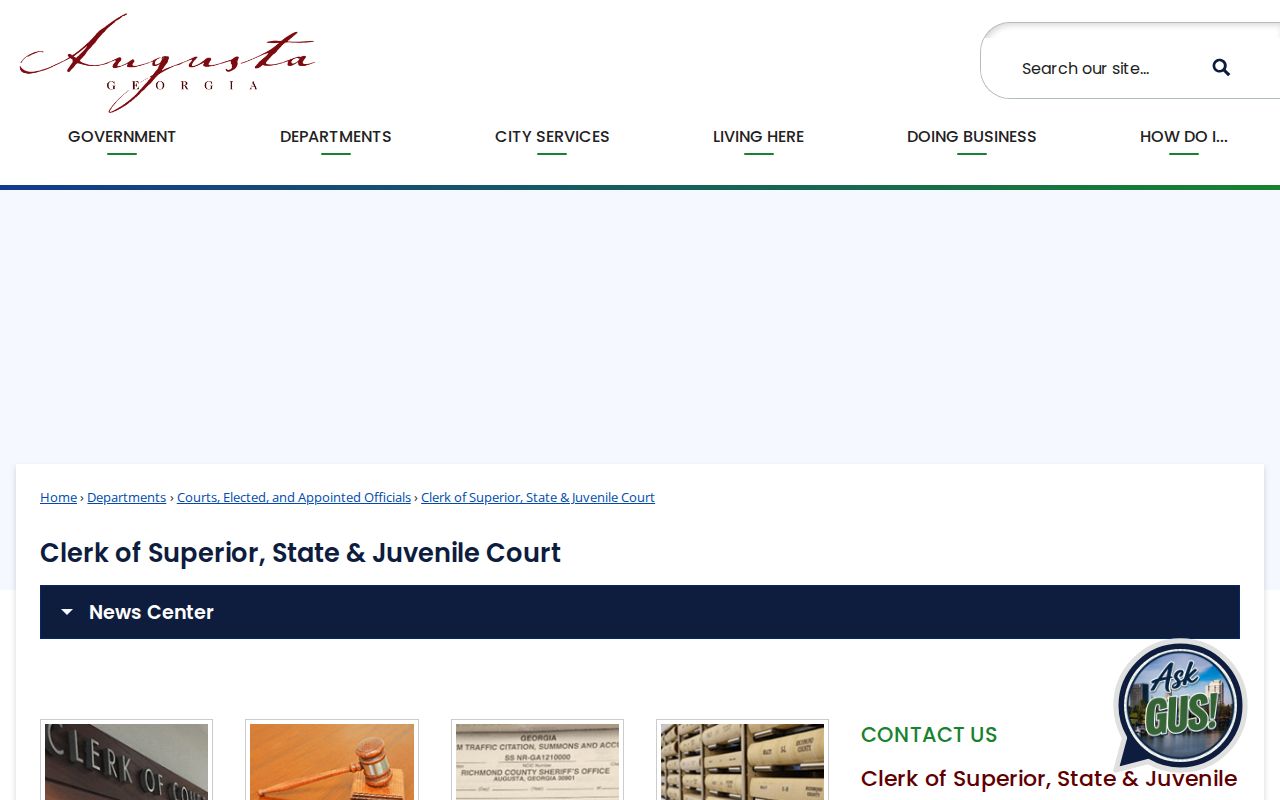
That clerk route is the fallback when a local case search fails, a deed predates reliable online coverage, or a plain or certified copy is needed.
Augusta Portal Has Boundaries
Augusta's Open Records Center accepts requests for covered executive departments, including Elections, Tax Assessor, Planning, Fire, Utilities, 911, Animal Services, and boards. It does not cover courts or the judiciary. It also excludes the Richmond County Sheriff's Office. Sending every request to the city portal can therefore produce a correct “not held here” response even when another Augusta office has the record.
The Augusta records FAQ explains scope, costs, and direct office contacts.
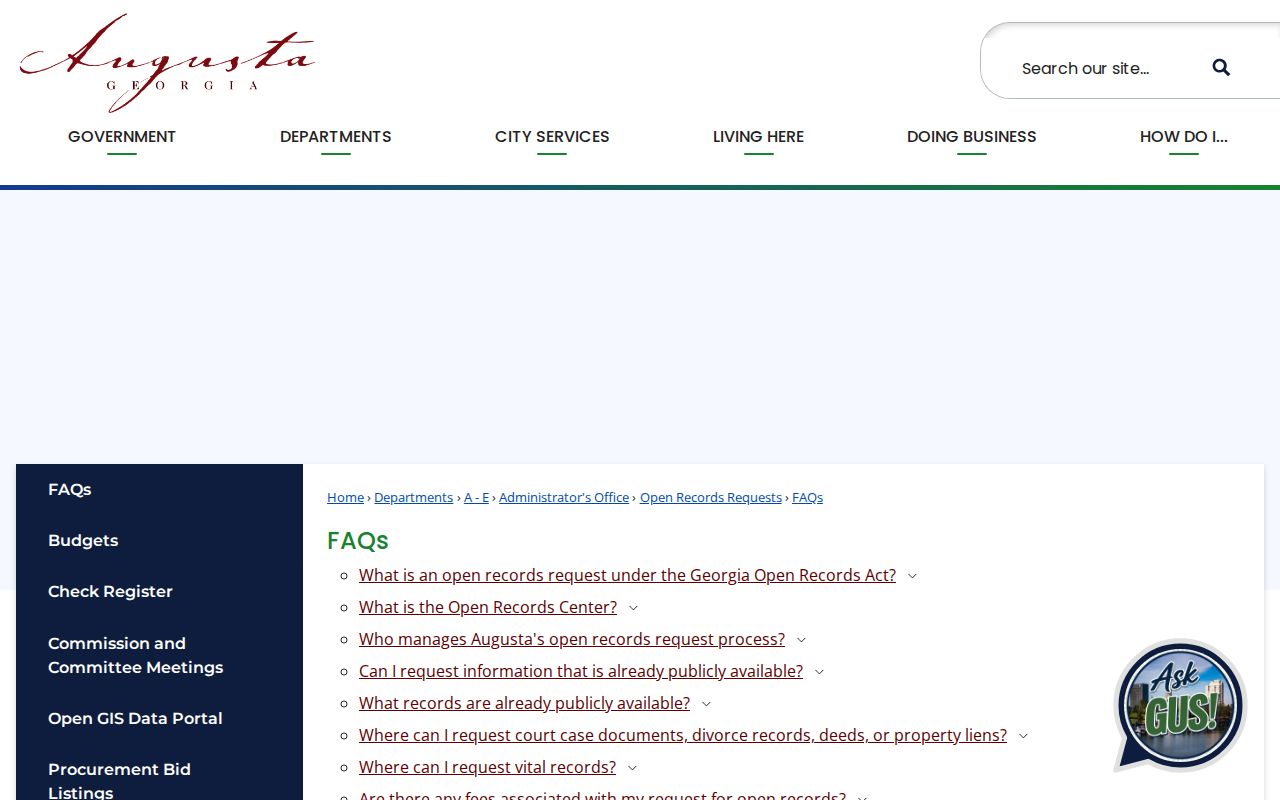
Its practical value is routing: court cases, divorce files, deeds, and liens go to 706-821-2460; local vital-record questions go to Probate Court at 706-821-2434.
The Augusta departmental request portal collects requests for the departments it does cover.
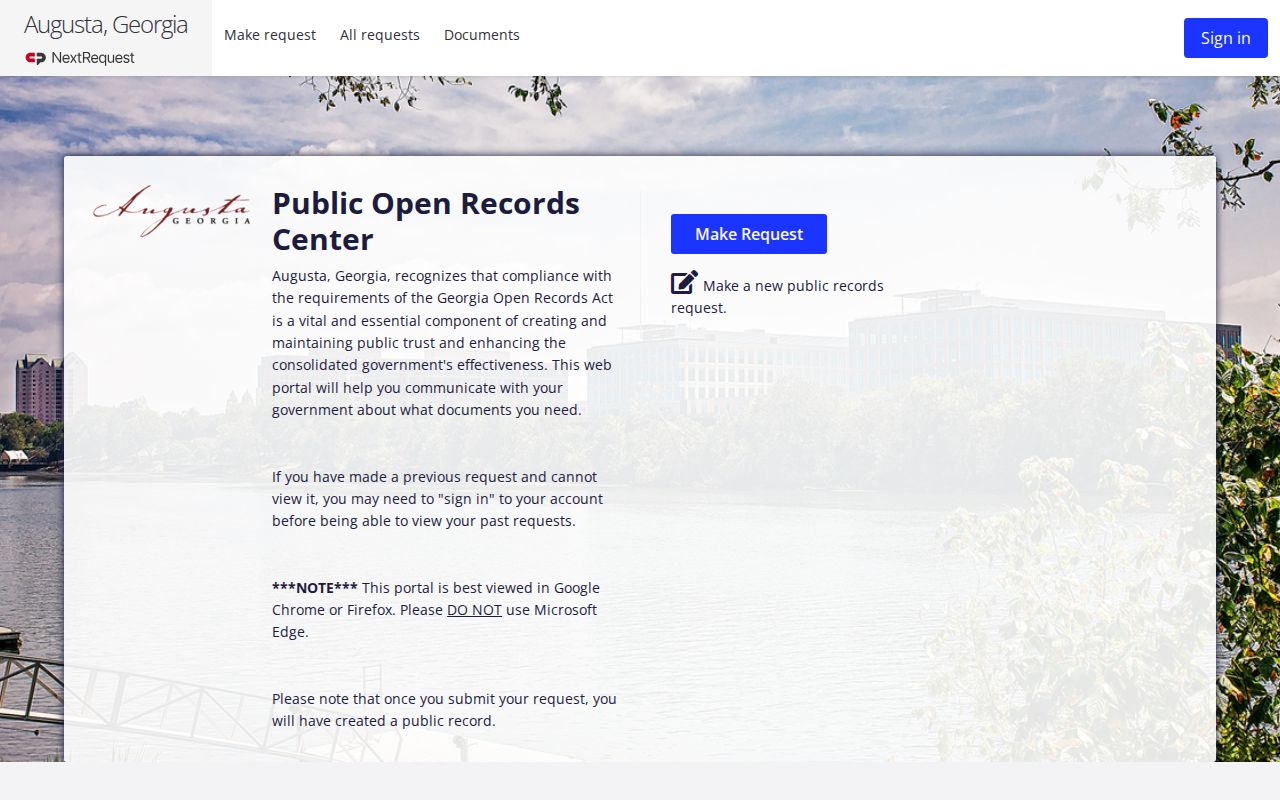
Use it as a routing and submission system, not as a universal name database. Describe an existing record and select the department that created or keeps it.
Routing rule. Send deeds and court files to the clerk, sheriff reports to RCSO, and covered department records through Augusta's center.
Augusta Property Record Layers
The Augusta Maps Property Search and assessor roll connect owner names with parcels, mailing addresses, situs addresses, values, characteristics, photos, sales, and tax context. A situs address is the physical parcel location. A mailing address is where the taxpayer receives notices and is not proof that the owner lives at the parcel. Augusta GIS also publishes maps and open datasets through its official gateway.
A current parcel record should be reconciled with the newest deed. Augusta's assessor warns that a recorded transfer may take up to one year to reach the ownership roll. Search the current parcel, note its parcel number and legal description, then check the grantee transaction in GSCCCA. For an older transfer, follow grantor names and book/page citations backward. If the map will not load, call the Assessor at 706-821-2310 or GIS at 706-821-4239.
Note: A parcel owner, taxpayer mailing address, deed party, and physical occupant can be four different facts and should remain clearly labeled.
Augusta Court Records Access
Richmond's local Case Management Search launches from the clerk site after a disclaimer, but its fields, dates, and result inventory could not be verified during research. The official page also warns that online material is not certified. A missing portal hit does not prove there is no case. Call or visit the correct clerk with a party name, approximate date, case type, and case number when known.
The Georgia electronic court access directory points to available systems by court.
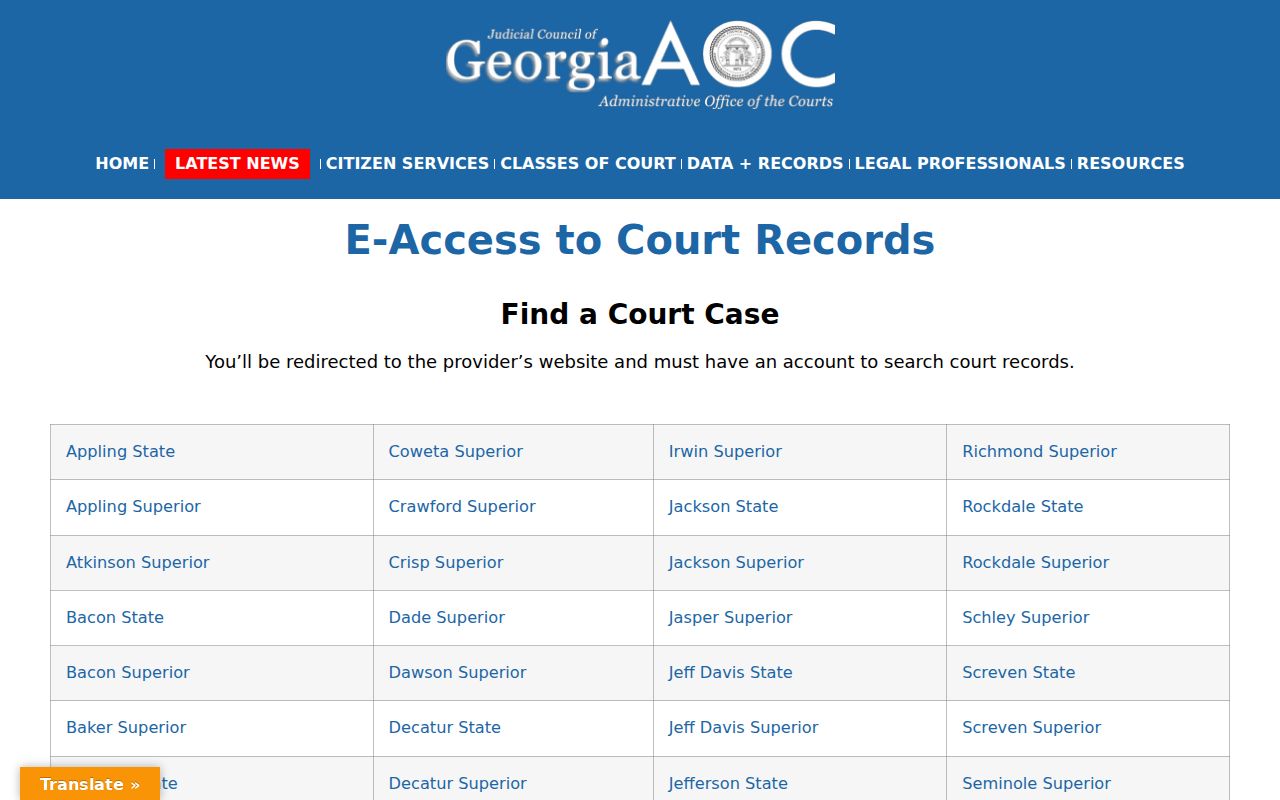
It is a directory rather than the custodian. Richmond Superior, State, and Juvenile files remain with the local clerk; Probate has no verified public name index; federal Augusta Division cases use PACER, the federal clerk, and NARA for some older material.
Open filings can show a docket, meaning the chronological list of filings and court events. Sealed cases, juvenile records, adoption material, protected identifiers, and confidential family content remain unavailable or redacted. When legal proof is required, obtain the filing from the custodian instead of treating a web display as certified.
Augusta Vital Records Limits
Modern birth and death certificates are not general public name indexes. Georgia DPH and the local vital office require an eligible relationship or legal authority, photo identification, the correct application, and payment. DPH holds statewide birth and death certificates and marriage records from 1952 through 1996. Richmond Probate Court handles Augusta marriages outside that span, while Superior Court keeps the actual divorce decree and DPH provides divorce verification.
The Georgia vital-record request service presents online, mail, and in-person options.
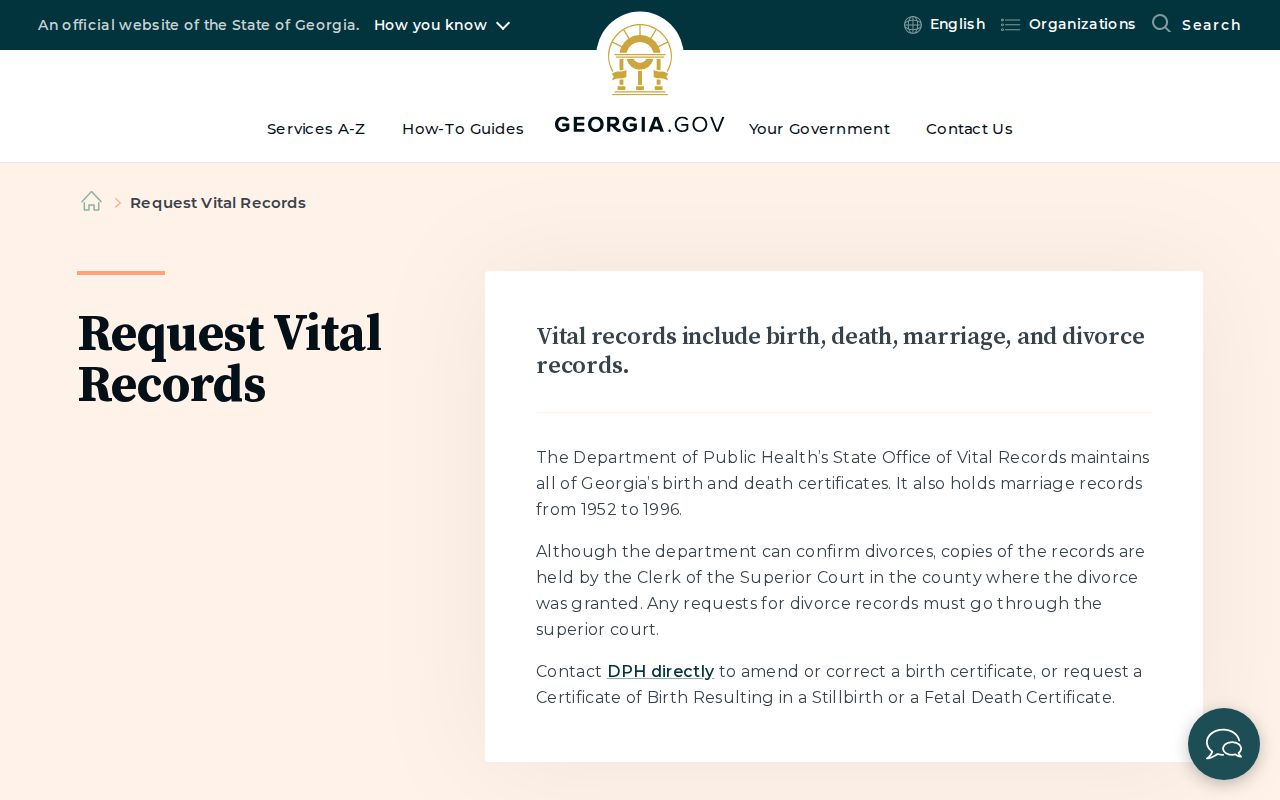
The state lists a $25 first certified birth or death copy and $5 for each added copy in the same order. Modern certificate access follows O.C.G.A. Title 31, chapter 10, especially §31-10-25. Georgia's official request material does not support a simple rule that every modern certificate opens automatically after a set number of years.
Historical research uses a different chain. Augusta began municipal death registration in 1904 and birth registration in 1919. Earlier evidence may lie in church, cemetery, newspaper, census, court, library, or Georgia Archives holdings rather than a modern certificate search.
Augusta Custody Record Searches
The Richmond County inmate inquiry searches recent bookings by last or first name and shows booking identity, arrest date, charges, bond, and disposition. Georgia DOC offers a separate statewide offender query. The GBI registry supplies statutorily public registry fields and is updated from agency submissions. Each tool covers a different population and time frame.
- Use the Richmond inquiry for current local booking evidence.
- Use Georgia DOC for state custody and sentence information.
- Use the GBI registry for the statutory offender dataset.
- Ask RCSO directly for arrest or traffic reports.
Sheriff reports do not go through Augusta NextRequest. Contact 706-821-1004 or RCSOOpenRecords@augustaga.gov. A booking is an arrest record, not proof of guilt, and registry data must never be used to threaten or harass anyone.
Augusta Records Beyond Online Indexes
Augusta's historical court holdings are unusually deep. Genealogical work cataloged roughly 58,000 loose Richmond Superior Court papers, and later preservation created an 822-page index to names of enslaved people in fragile court and Archives material. These finding aids can expose names that do not appear in a modern case portal, especially for African American family research and nineteenth-century estates, disputes, and transactions.
Start with the clerk for the record citation, then use the Georgia Archives, library Heritage Room, microfilm, or archival staff when custody or format has shifted. Give surname variants, an approximate date, document type, and any book/page or case number. Ask whether inspection, a plain copy, or certification best fits the need.
Note: Online absence can reflect age, spelling, sealing, court choice, or portal limits; it is not proof that no Augusta record survives.
Augusta Record Fees Differ
General GORA costs and clerk certification fees are not the same. Augusta gives the first quarter-hour of search, retrieval, redaction, and production labor without charge. Later labor uses the prorated rate of the lowest-paid qualified employee. Ordinary letter or legal pages are capped at ten cents each. The city supplies a detailed estimate when expected cost exceeds $25, may require prepayment, and reviews estimates above $500.
Court copies follow the clerk's July 2024 schedule: self-service copies cost fifty cents per page, assisted copies cost $1 per page, and a certified or exemplified copy begins at $2.50 for the first page plus fifty cents for each later page. Probate marriage research is $10 per marriage; plain pages are $1, while certification is $10 plus $1 per page. Ask for the current schedule before ordering because fees are volatile.
| Copy route | Research-confirmed charge |
|---|---|
| GORA paper copy | Up to $0.10 per letter/legal page |
| Clerk self-service | $0.50 per page |
| Clerk assisted | $1 per page |
| Certified court copy | $2.50 first page, then $0.50 per page |
| Vital birth/death certificate | $25 first, $5 same-order additional |
Request Augusta Public Records
The Georgia Open Records Act, O.C.G.A. §50-18-70 through §50-18-77, lets any person request existing agency records without a state-residency rule. A written request creates the clearest record of scope and timing. Describe the document rather than asking staff to investigate a person or create a new summary. The law does not require an agency to build a report that does not exist.
- Name the custodian. Route court and deed files to the clerk, sheriff records to RCSO, and covered department material to Augusta's center.
- Describe existing records. Give names, date range, department, address, and case, document, or parcel number when known.
- Choose a format. Ask for electronic inspection or a plain copy unless certification is truly needed.
- Review the response. The agency must respond within three business days, but a large request may receive a timetable and cost estimate instead of full production.
- Address a denial. Ask for the exact exemption and release of reasonably separable public portions.
The Georgia Attorney General's request guidance explains written requests, exemptions, and enforcement. If an office does not produce records within three business days, its timely reply should identify responsive material, give a reasonable timetable and estimate, or cite the law supporting a denial. An unsupported refusal can be raised through the Attorney General's Open Government Mediation Program or superior court.
Lawful personal use. Public access is not permission to stalk, harass, intimidate, or expose protected data. Use records for lawful personal research and verify important facts with the custodian.